
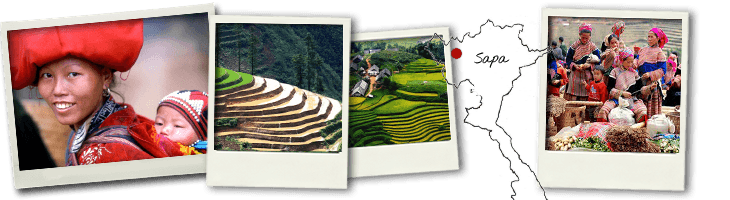
Sapa compte parmi les plus beaux paysages du Vietnam. Son nom signifie « ville de sable » en vietnamien. Cette ville, située au sein des Alpes tonkinoises est toutefois connue pour sa verdure et ses incroyables rizières en terrasse. C’est aussi l’endroit idéal pour aller à la rencontre des minorités du Nord du Vietnam, comme les Hmongs.
Sapa

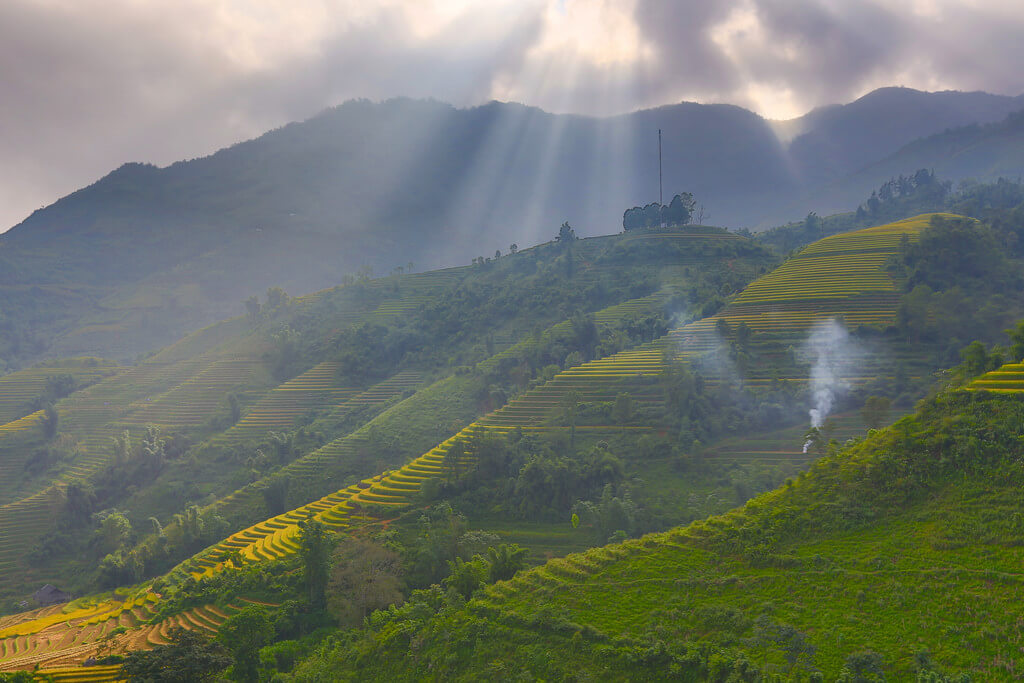
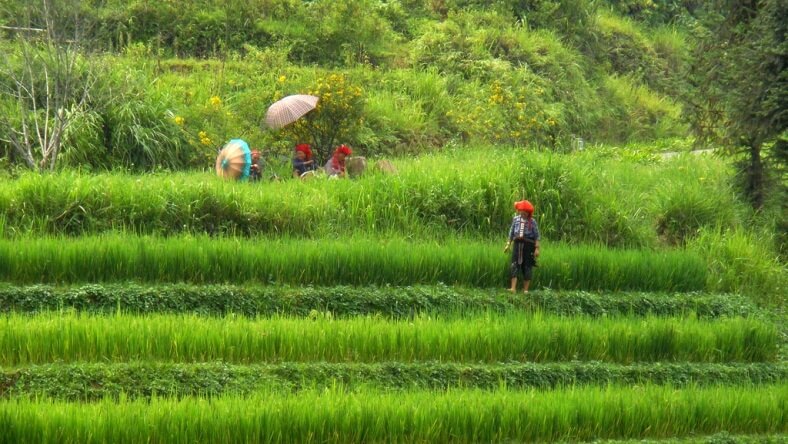
Vues du ciel, les rizières en terrasse ressemblent à un miroir brisé émaillé, dont la palette de couleurs s’étendrait du vert foncé au jaune doré. En vous approchant de ces plantations inondées, vous comprendrez la prouesse technique que constitue cette culture traditionnelles. Ces retenues d’eau séparées par de fines digues de terre renferment le grenier du Vietnam.

Ces puzzles de couleurs sont des lieux encore très authentiques où se retrouvent les villageois qui viennent vendre leurs produits. Ainsi vous passerez à côté d’une vendeuse de tenues traditionnelles rosées mais vous pourrez tout aussi bien croiser un paysan venu vendre ses buffles. C’est donc dans une ambiance mercantile mais toujours très calme que vous pourrez découvrir ces populations coupées de la modernité et très attachées à leurs traditions rurales.

Ce mont de 3143m d’altitude est considéré comme le plus haut du Vietnam. C’est pourquoi il représente une réelle expédition pour tout alpiniste qui s’y aventurerait. Une très bonne condition physique ainsi qu’une force mentale sont nécessaires car la pente peut parfois être très raide et le dénivelé important. Si vous acceptez ce défi, vous ne serez pas déçu de la vue à couper le souffle qu’on a depuis le toit de l’Indochine.

Dans les montagnes vivent trois peuples distincts. Les Hmongs, présents dans d’autres pays d’Asie, sont originaires de Chine. Leurs revenus proviennent de ressources agricoles telles que l’élevage et la riziculture. Les Dao, quant à eux ont la particularité d’écrire en caractères chinois et d’être taoïstes. Les Tay sont issus d’un troisième groupe ethnique. Ils pratiquent la riziculture inondée principalement dans les vallées ou les plaines. Ces trois peuples se distinguent par leurs tuniques aux couleurs vives et leurs coiffes qui retiennent les cheveux en chignon.

Les « chutes d’argent » sont situées à Thac Bac, à 13 km de la ville de Sapa. Il s’agit en réalité d’une cascade, qui se trouve au niveau du plus haut col du Vietnam. Elle mesure une centaine de mètres de hauteur et produit un fracas assourdissant. La cascade tire son nom de la brume argentée qui s’échappe d’entre les eaux. Ses différents segments glissent sur la roche, créant une ambiance magique ponctuée d’aventures. L’autre particularité du lieu réside dans l’élevage de saumons. L’idéal est de se rendre en moto sur le site de Thac Bac, en partant de Sapa.
Situation géographique
Sapa se situe dans le Nord-Ouest du Vietnam, dans la province de Lao Cai, près de la frontière chinoise. Cette ville est perchée à une hauteur de 1500-1650m au-dessus de la mer, sur un affluent du fleuve Rouge (Sông Hông).
Traditionnellement, la région était connue pour sa production d’opium, mais dans la 2e partie du 20e siècle, cette pratique fut interdite et donc remplacée par la riziculture. Les rizières en cascade ou en terrasse se firent alors de plus en plus nombreuses, ce qui changea le paysage.
Ce lieu pittoresque, qui ressemble maintenant à une station hivernale, intéressa très vite les colons français qui y construisirent un poste militaire au 20e siècle, les prémices de la ville qui s’y tient aujourd’hui, ainsi qu’une mission catholique. En 1913, un sanatorium dédié aux militaires français fatigués fut créé, qui cherchaient à fuir la chaleur. On prêtait aussi des vertus miraculeuses à Sapa, ce qui en fit une référence en terme de bien-être. La ville se développa petit à petit autour, et devint vite touristique.
Sapa, la neige et le soleil
L’une des choses qui attira les Français à l’époque fut le climat de la région, qui est plus froid que le reste du pays : le climat est modéré et la température moyenne est de 15-18 °C alors que le sud présente une température moyenne est de 27,5 °C. Logique, à plus de 1500 mètres d’altitude ! Même en été, il n’est pas rare qu’il fasse frais, il est donc recommandé d’emporter des vêtements chauds. En hiver toutefois, les températures deviennent vraiment froides, au point que, parfois, Sapa se retrouve sous la neige. Les rizières et les montagnes se transforment alors en un paysage insolite recouvert d’« or blanc », qui rappelle énormément les Alpes.
Minorités ethniques et marchés
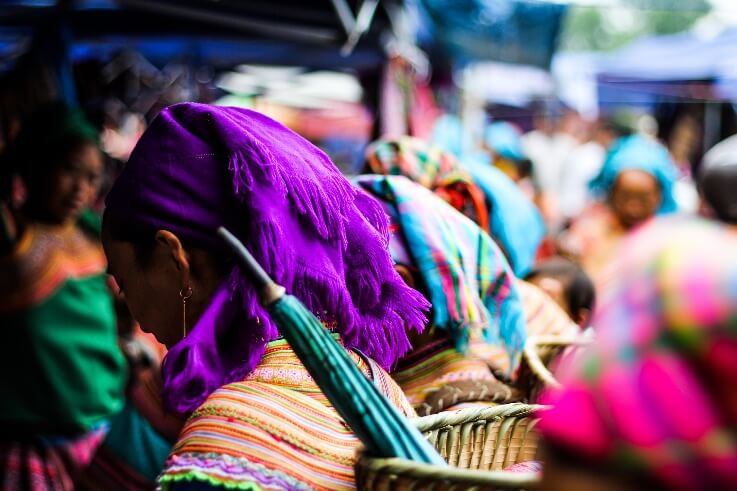
Située dans la chaîne de montagne Hoang Lien Son, dans les Alpes tonkinoises, Sapa est une ville réputée pour les paysages alentours, mais aussi pour les ethnies qui y passent. Parfois appelés « montagnards », ces habitants font partie des 54 minorités ethniques du Vietnam et habitent dans des hameaux non loin de Sapa. Ils sont facilement reconnaissables à leurs costumes traditionnels, leurs bijoux et leurs pompons. À Sapa, on croise surtout des Hmong et des Dao, venant commercer au marché dans un beau spectacle de couleurs.
Le marché de Sapa
Le marché de Sapa est sûrement le marché le plus connu de la région. On peut y voir des femmes Hmong Noirs en costume traditionnel déambuler entre les échoppes et vendre des produits artisanaux fait main comme des bijoux ou du tissu, le même qu’elles coudent pour faire leurs costumes. Il leur faut parfois des mois pour en coudre un, mais le résultat est incroyable, et incontestablement l’un des meilleurs souvenirs que vous pourriez ramener. Ce marché est ouvert tous les jours.
Le marché de l’Amour
Il s’agit d’un marché traditionnel qui a lieu un jour par an. Il permet aux jeunes couples de se former et aux couples mariés de se retrouver ou de retrouver leur amour de jeunesse. Cette fête vieille d’un siècle est maintenue par les Hmong et les Dao, pour que filles et garçons puissent se rencontrer, danser, et peut-être trouver leur moitié. La coutume veut que les filles revêtent leur plus bel habit et leurs plus beaux bijoux, et que les garçons se mettent sur leur 31 (plusieurs turbans enroulés autour de la tête) pour tenter de séduire les jeunes filles à coup de flatteries, de chants et de petits cadeaux.
Le marché de Bac Ha
Pour un marché plus authentique, rendez-vous au village de Bac Ha pour voir son marché montagnard qui est le plus animé, le plus grand du Nord et sans doute aussi le plus coloré. À 2-3h de route de Sapa, vous pourrez y voir des Hmong Fleurs dont le costume traditionnel diffère de celui des Hmong Noirs, ainsi que des Dao. Flânez d’un étalage à un autre au gré des sourires des habitants et des odeurs de pho et de thang co, la spécialité de Bac Ha. Ce marché a lieu le dimanche.
Le marché Can Cau
À flanc de colline, ce marché se trouve à environ une demi-heure de Bac Ha. Il est moins touristique que ce dernier, ce qui le rend d’autant plus intéressant. Entouré de rizières en terrasse, les routes pour y accéder ne sont pas en bon état, mais l’on y voit des paysages spectaculaires. Ce marché a lieu le samedi.
Les sites à voir
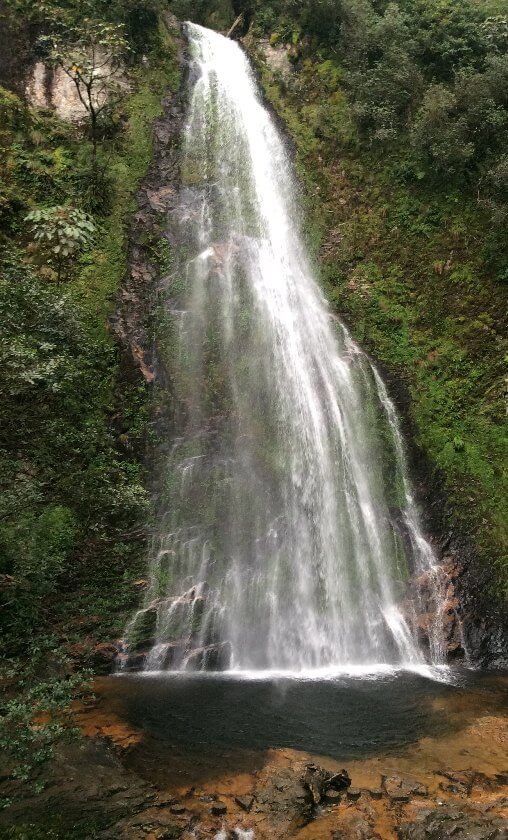
L’un des sites à voir à Sapa est Thác Bạc, aussi joliment appelé les « chutes d’Argent ». Il s’agit d’une cascade haute de 100 mètres, à une altitude de 1800 mètres. Pour une meilleure vue, un pont de bois a été placé au milieu de l’eau.
La Porte Céleste se trouve à proximité de la cascade d’Argent et offre une vue imprenable sur les montagnes, dont le mont Fansipan, dit Phan Xi Păng qui est le plus haut sommet de toute l’Indochine (haut de 3143 mètres). Monter jusqu’au sommet requiert une bonne endurance, cependant il n’est pas nécessaire d’avoir des connaissances en escalade : le chemin est très praticable bien qu’en pente raide. La végétation est parfaitement préservée et fait de ce lieu l’une des plus grandes réserves naturelles du Vietnam, aussi appelée le parc national de Hoang Lien.
Ce parc, sur la route de Lai Châu, compte 20% de la flore nationale, et pratique plusieurs activités, comme l’extraction d’huile et d’autres composants à des fins pharmaceutiques. La richesse de cette réserve naturelle lui vaut d’être reconnue par l’ASEAN. On y trouve aussi quelques ethnies minoritaires comme les Hmong, les Day et les Giay qui y vivent. Il est possible de se rendre à leurs villages pour les rencontrer, et même d’assister à certaines de leurs activités sportives et artistiques traditionnelles. Un lieu qui plaira aux « éco-touristes » !
Dans le bourg de Sapa, l’ancienne cathédrale détonne avec le reste du paysage. Elle fut construite en 1895 avec des pierres dans un style romano-gothique. Il s’agit d’une des cinq plus vieilles églises (datant de plus d’un siècle) du Vietnam, parmi les plus connues.
Pour une vue panoramique du bourg de Sapa, vous pouvez vous rendre à la montagne Ham Rong, signifiant le mont de la Mâchoire de Dragon. Elle fut appelée ainsi pour sa forme, et se trouve à proximité du centre de la ville de Sapa. Pour la plus belle vue possible, San May, le Jardin nuageux, est le meilleur observatoire pour admirer les fleurs d’arbres fruitiers en contrebas. On peut aussi faire un trek de 2h dans les alentours, et accéder au magnifique Jardin des Orchidées et ses quelques 6000 pots aux 200 sortes d’orchidées. Cette montagne renferme d’autres trésors comme la grotte de Tam Mon.
Spécialités culinaires
L’une des spécialités les plus connues de Sapa et dont les locaux et visiteurs raffolent, est le thang co, une soupe traditionnelle préparée avec de la viande de cheval à la poêle sur un four en terre. Ce plat vient de Bac Ha, et peut aussi être préparé avec de la viande de buffle ou de chèvre, bien que son nom signifie littéralement « cheval soupe ».
Le com lam est une spécialité culinaire à base de riz gluant qui nous vient des Muong, une minorité ethnique : autrefois, les Muong n’avaient pas les ustensiles adéquats pour cuisiner le riz, et utilisaient donc des longs tubes de bambous pour le cuire. Cette technique continue d’être utilisée aujourd’hui : des tronçons de bambous sont remplis de riz gluants, puis grillés jusqu’à ce que l’écorce soit calcinée. Puis cette écorce est retirée pour ne laisser que la chair blanche du bambou, qui entoure le riz. Elle n’est pas jetée et se déguste froide, accompagnée de poulet, de porc ou de pousses de bambous.
Pour tout projet ou information complémentaire, merci de nous contacter !

