
In Central Vietnam lies Hue, the former capital city of the country under the Nguyen dynasty. Hue had a hectic past, especially during the war. A lot of monuments still stand as proof of its interesting history and give the place a good reason to be listed on the UNESCO World Heritage List.
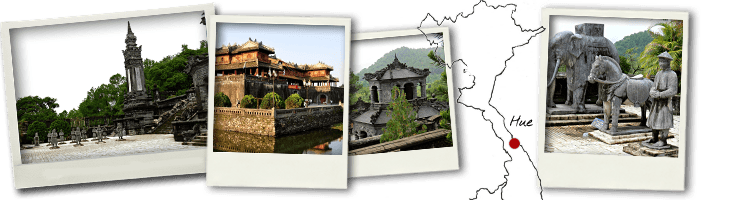
Hue
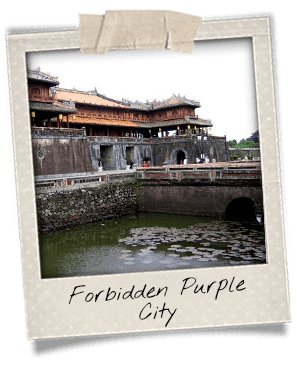
Along the Huong River (Perfume River), the Citadel consists in 2 kilometers by 2 kilometers of fortified ramparts along with a moat protecting the Imperial City. Within the latter stands the Forbidden Purple City, which access is restricted to the imperial family only. The place suffered from bombings and shootings during the Indochina War. Besides, the Northeast Gate (Mang Ca) is now a military basis.
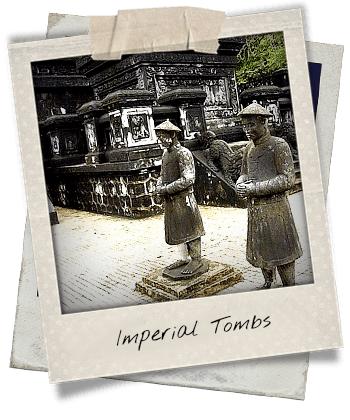
Hue’s imperial tombs are not only places for burial but for emperors to live apart from the court and also beyond death. Each tomb is special and must not resemble any other, exactly like princes and mandarins. Living epicureans have the same needs in the afterlife: eating, sleeping, working and being entertained. In order to make sure that those needs would be fulfilled, emperors used to supervise works throughout their whole life before being buried with their treasures.
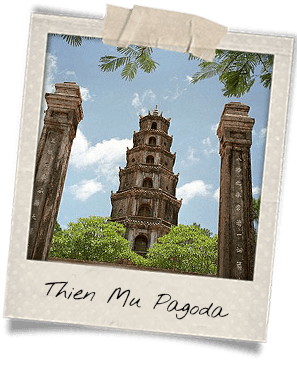
The seven stories of Thien Mu Pagoda represent Buddha’s reincarnations. The octagonal tower, Thap Phuoc Duyen, was built in 1844 by Emperor Thieu Tri, and it stands now as an unofficial symbol of Hue. In the background, you may see three different buddhas: one from the past, A Di Da, one from the present, Thich Ca, and one from the future, Di Lac. The riverside is a great venue to enjoy a bicycle tour in the morning. Also have a glimpse at the Bonsai Garden.
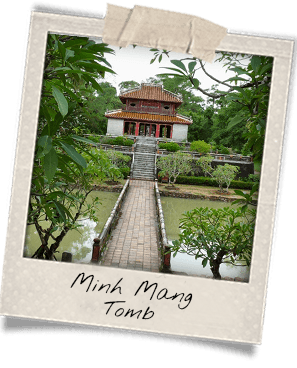
Minh Mang Tomb is known to be one of the most sumptuous tombs in Hue. It is the only one that has been built after the death of an emperor. Indeed, Minh Mang never had the chance to enjoy it, though he had prepared all the plans. Have a walk to the Honour Courtyard through gates, bridges, pavilions and hedges.
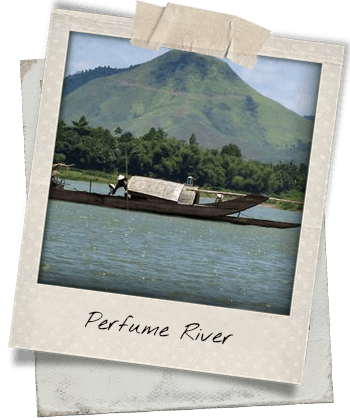
The Perfume River used to be crowded with medicinal and perfumed plants. It crosses Hue city in the middle, from North to South. When embarking for a cruise on the river, don’t forget to have a look at the dragon head painted on the stern of the boat – it is here to protect you. Grab the chance to visit sampan villages and the Imperial Tombs. Take advantage of the particular light of the river and load your camera with wonderful pictures!
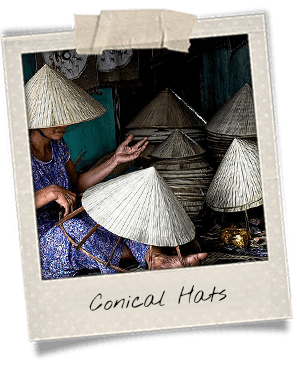
The tradition of conical hat is more important in Hue than any other Vietnamese city. Phuoc Vinh and Vinh Loi are two main factories for this hat. It is a symbol of Vietnam. Beyond cultural involvements, the so-called non la is used in the countryside, in rice fields, under the burning sun, but also in cities and during the rainy season. It is an important element of the basic protection gear. Worn with the famous ao dai, the conical hat contributes to the city’s charm.
The City
Hue is crossed by the Perfume River, also referred to as Huong River, which divides the city. The oldest part is in the North whereas the newest is in the South. A few centuries ago, the city belonged to the kingdom of Champa, before being given to the Nam Viet kingdom in the 13th century. Later in the history, in the 16th century, King Nguyen Hoang fled Hanoi because of the Chinese, and he took shelter in Hue, where he founded his own dynasty. From that moment on, Hue became the political center of the country. The Tay Son dynasty in the 18th century lived there, as well as the Nguyen dynasty, who ruled over Hue from 1802 to 1945 with 13 different emperors.
The Imperial Tombs
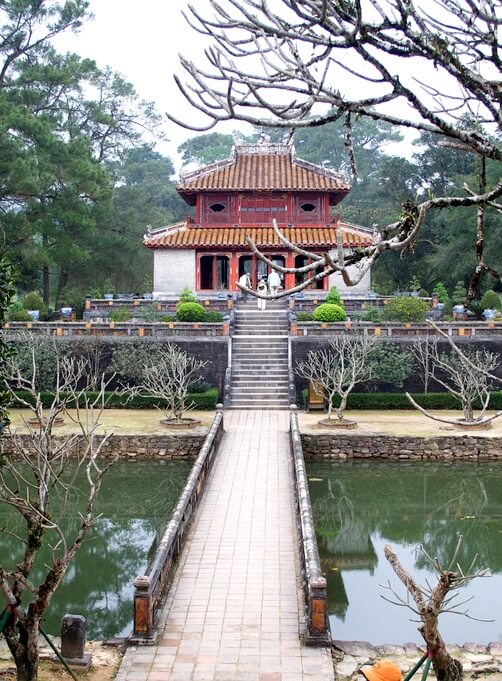
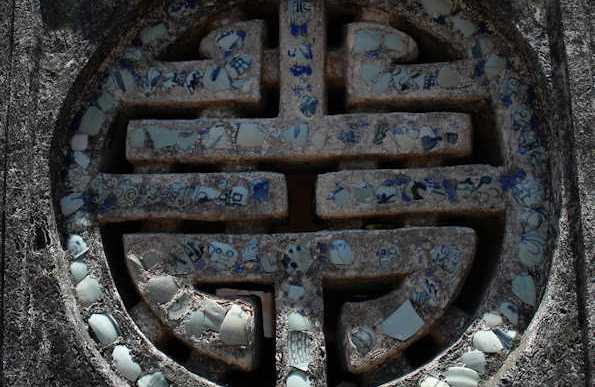
As the capital city of Thua Thien Province, Hue houses several national treasures, such as seven imperial tombs in the South of the city. Each mausoleum is divided in two: the lang part, the tomb, and the tam part, where people used to live and honour the emperors, along with palaces and altars. While on a tour to one of those tombs, visitors have then the opportunity to see temples, pavilions, and gardens from each emperor, and to get a closer look at their personalities.
Every tomb has been built according to Feng Shui principles, a Chinese philosophical system harmonizing human beings with their surrounding environments. In Vietnam, it is often believed that dead people live in the afterlife as spirits, hence a necessary good environment where tombs are built. As a consequence, tombs are very close to natural elements such as water and earth. Besides, the buildings are surrounded with small lakes, rivers, water basins, gardens…
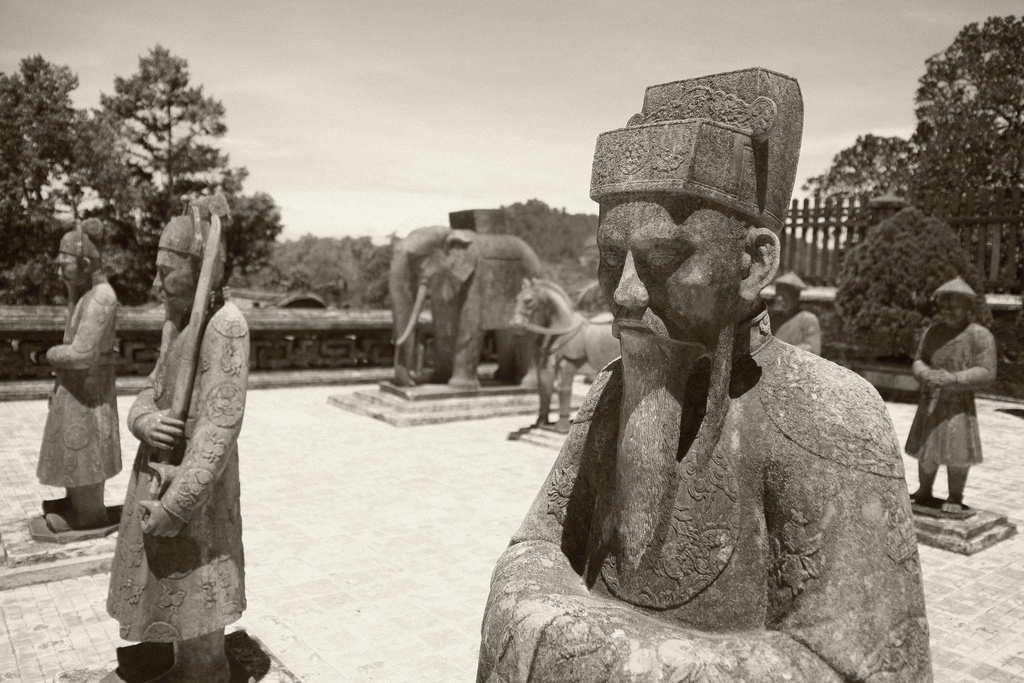
One of the most sumptuous mausoleums is Tu Duc Tomb, which stretches for 225 hectares. The emperor decided to name it Khiem (“modest”) because he freely admitted that he had made mistakes. The tomb contains several palaces, a theater, a museum and a lecture pavilion, but also a big lake surrounded by overhanging gardens. Tu Duc liked philosophy and poetry. He used to spend a lot of time writing in his palace while contemplating the lake and the gardens. When he died, his body was put in a secret place, and to make sure that no one could ever reveal the location, every worker was beheaded.
The seven succeeding Emperors buried in Hue:
- Gia Long, who was the most unpopular
- Minh Mang, Chinese architecture including 40 funerary buildings
- Thieu Tri, who did not erect his tomb while he was alive
- Tu Duc, who ruled the longest (36 years), next to his 104 wives
- Duc Duc, who only ruled for 3 days
- Dong Khanh, who had the smallest tomb
- Khai Dinh, who had the most impressive tomb
Other Major Monuments
The Forbidden Purple City
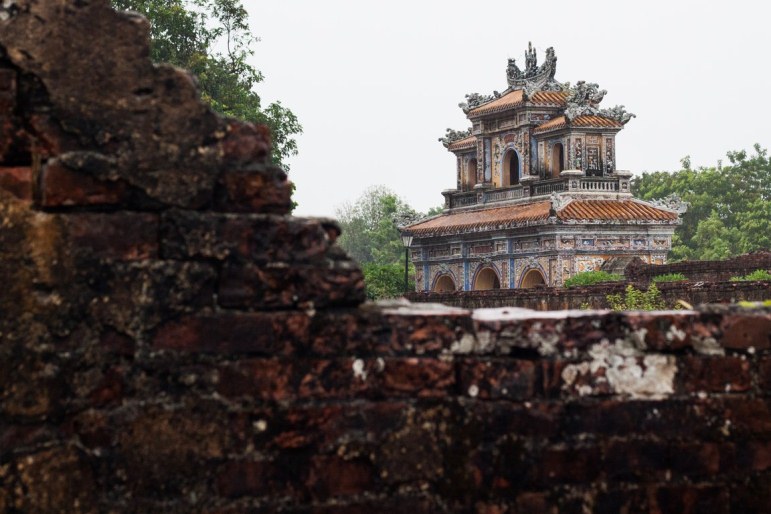
Alongside the Perfume River, Hue’s Forbidden City, very similar to Beijing’s, is also referred to as Purple City, and it was the house of the empress (the mother queen) and of the emperor’s concubines. The few men who were allowed to enter the Forbidden City without being immediately executed were the emperor himself and eunuch servants. It is the last imperial city still standing in Vietnam.
The Citadel
Hue’s Citadel is listed on the UNESCO World Heritage List. It was built in 1805, and it surrounds the Imperial City and the Forbidden City. At the gate of the citadel lie 9 sacred cannons, which represent the Five Elements (Water, Wood, Fire, Earth, Metal) and the Four Seasons.
Thien Mu Pagoda
Its name literally means “heavenly lady.” Thien Mu Pagoda is a historic building which became an unofficial symbol of Hue. From the river, its seven story tower stands out from the cityscape. Legend has it that long ago, local peasants saw an elderly woman at this very place. She predicted that a grand lord would build a pagoda at this Buddhist favorable location and would then become the founder of a great dynasty. While hearing this, Emperor Hoang decided to believe the elderly woman and had a pagoda built in 1601 which he named “heavenly lady.” The current pagoda comprises a tower called Phuoc Duyen (formerly Tu Nhan) in which each story represents Buddha’s reincarnation, i.e. the seven stages of Enlightement to reach the nirvana.
The place also contains Dai Hung Shrine behind a three door gate displaying statues of Buddhist guardians, brass sculptures, a gong, two houses – one for monks, one for visitors –, and a splendid flower garden.
Local Cuisine
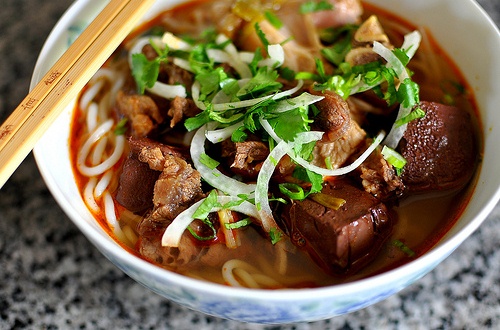
Hue’s local cuisine is worth the discovery. Two specialties stand among the others: com hen (mussel rice) and bun bo Hue (beef noodles).
Com hen consists of cold sautéed mussels, rice cooked with star fruit, onions, peanuts, aromatic herbs and pepper. On the table, ingredients are served separately. You will have to mix them together in a small bowl, to add the mussels and shrimp sauce and vegetables.
Bun bo Hue is made of a soup with rice noodles and beef. Bun means “noodles” and bo “beef.” The latter is sautéed with fresh onions then served with mint, cucumber, aromatic herbs and smashed peanuts. The oil that has been used to cook the onions is finally served on top of it.
Both dishes can be found everywhere in Hue’s streets. If you feel like trying some typical gastronomic cuisine, book a table at Tha Om Garden House, a restaurant located in a former mandarin house in the middle of a sumptuous garden. The place also provides cooking classes.
Should you want more information, please contact us:

